Solar in winter — what your system really produces
The short version: in winter, a PV system in central/northern Europe typically produces 3–5% of its annual yield per month — December often under 2%, and an overcast December day can squeeze just 0.5–1 kWh out of 5 kWp. Little, but not nothing. And that’s exactly why one piece of information matters more than anything else in winter: which day will be the sunny one.
Real numbers from a 5.2 kWp system
The reality, month by month: ~79 kWh in November, ~32 kWh in December (barely 1 kWh/day — the yearly floor), and ~100 kWh in February once the snow cleared around the 13th. Best day of the stretch: 12 kWh in late February; the worst were near zero under snow.
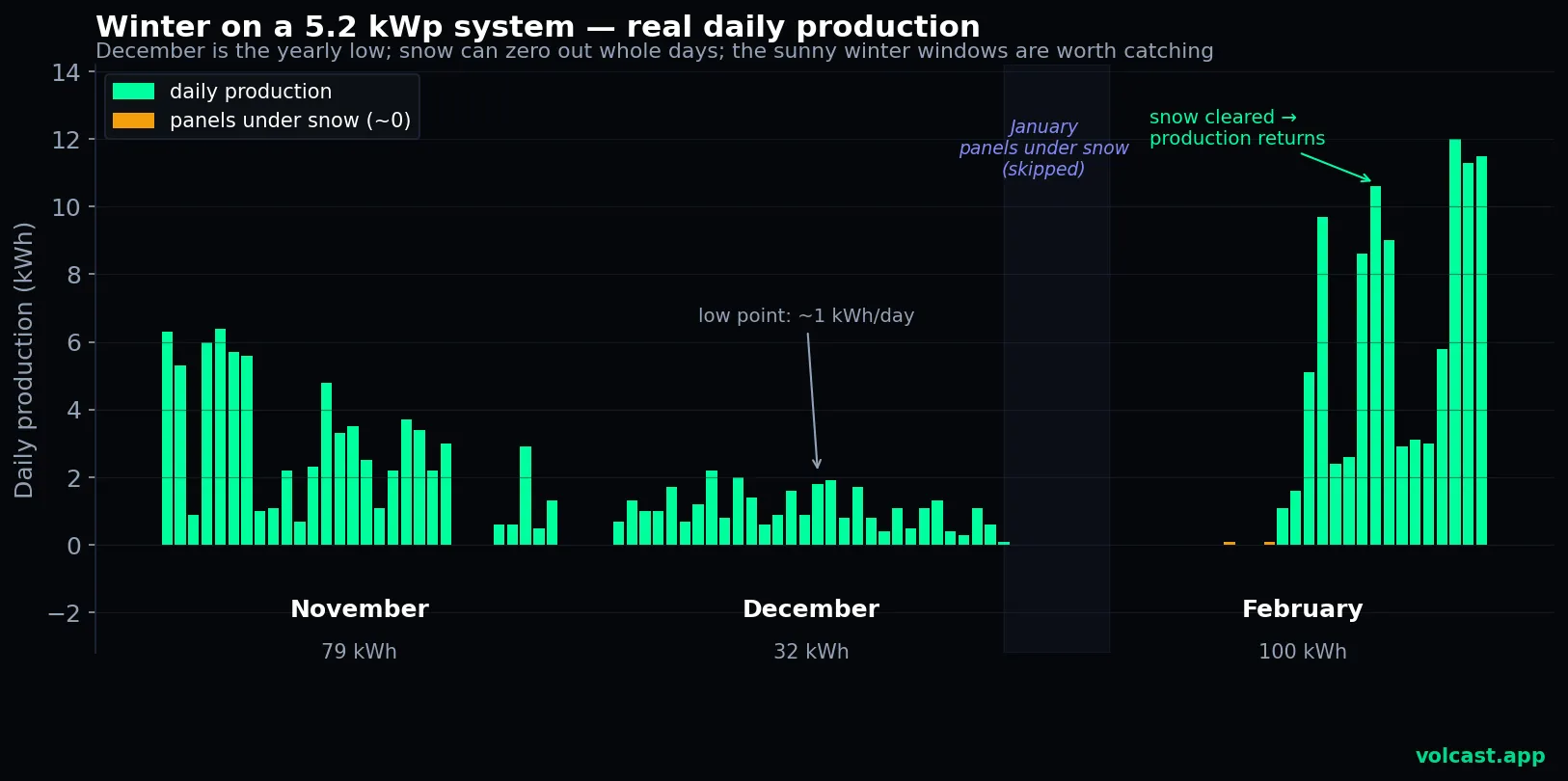
The order of magnitude: November 100–150 kWh, December 60–100 kWh, January 80–130 kWh, February 150–250 kWh. But averages mislead — winter production is extremely “lumpy”: 60–70% of a month’s yield often lands on 5–7 sunny days, while the rest of the month trickles.
Why winter is so lean
Three factors at once: short days (the December sun is up for ~8 hours), a low sun angle (light grazes the panels, and shading from neighbouring buildings reaches much further), and weather (thicker, more frequent cloud decks). Snow matters less than people think — it slides off tilted panels within a day or two, and fresh-snow albedo even helps slightly. The upside: cold improves cell efficiency, so a frosty sunny hour yields more than intuition suggests.
The winter strategy: catch the windows
When production concentrates into a handful of days, the whole game is using those days fully: laundry, dishwasher, hot-water tank to maximum. On the other days, don’t pretend the sun is shining — plan consumption around the tariff, not the roof.
Catching the windows is what a forecast is for: a “sunny day tomorrow, 12 kWh forecast” notification is worth more in November than in July — July forgives having no plan, November doesn’t. How such a forecast works: Solar production forecasting →.
Should you “do something” to the system for winter?
Usually not. A steeper tilt helps in theory and is rarely practical or economical in reality. Snow clearing: only safely from the ground with a soft brush, and only if the forecast shows a sunny streak ahead — for one overcast day it’s worth risking neither the panels nor your neck.
FAQ
Do panels produce anything under overcast skies? Yes — on diffuse light, typically 5–25% of rated power depending on cloud thickness. A bright overcast day yields a few kWh; a dark rainy one, fractions.
Is load-shifting worth it in winter? Only on days with a real surplus — which is why the decision should follow the forecast, not the calendar. On overcast days the cheap tariff window wins.
What share of annual production falls on Nov–Feb? Typically 8–12% combined. That doesn’t make winter irrelevant — it makes it the season when every sunny day must be used in full.